
Interview with the founders of BAAM
Sofia Nordmann and José Contreras Aguad: mapping the path of Berlin’s art scene
BAAM (Berlin Artists Art Market) is a Berlin-based initiative founded by Sofia Nordmann (Argentina/Germany) and José Contreras Aguad (Chile) to connect the public directly with artists and support emerging creatives. Sofia, an artist with a background in art history and theatre, and José, an architect turned cultural community-builder, met at Monopol — a former liquor factory turned art hub — and bonded over their passion for collaborative culture. BAAM’s markets mix the energy of grassroots art scenes with fair economics: artists keep 70% of sales, and everyone contributes to running the event, creating a warm, collective spirit. Since launching in Berlin, the format has expanded to Hamburg (HAAM) and is eyeing new cities, focusing on places with vibrant, accessible local art communities rather than exclusive, high-end circuits.
Share:
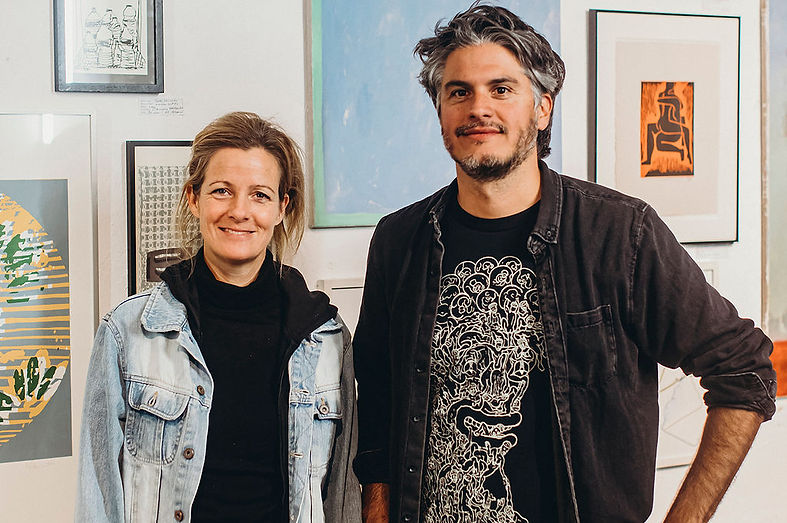
Sofia Nordmann and José Contreras Aguad, founders of BAAM (Berlin Artists Art Market)
BLAU: Hello! To start with, tell us a bit about yourselves. How did you come into the world of art, and what led you to create BAAM?
Sofia: I’m originally from Argentina, though I have German roots. I've been obsessed with art since childhood – I started painting when I was twelve and always knew I wanted to dedicate my life to it. I studied art history and theatre, but I didn’t study art at university – instead, I learned directly from artists. Today, I work as an artist and dedicate most of my time to BAAM. I also have three children – they’re almost grown now. And fun fact – José and I met at Monopol, a former liquor factory turned art space in Reinickendorf. I had a studio there and we were both involved in organizing big art events. That’s where the idea for BAAM was born.
José: I’m from Chile, an architect by training, focused on urbanism and social design. I moved to Berlin about 12–13 years ago – I knew the city from my university days and always dreamed of coming here. At first, I worked as an architect, but gradually I got more and more involved in cultural and social projects. I did urban initiatives, housing projects, and eventually shifted to art – but always with a social perspective. I stopped building houses and started “building” cultural communities instead.
One of my earlier projects was Chile Connection – a festival and platform for Chilean artists in Berlin. They showed their work to the public, and the project was a success. That experience planted the seed for what later became BAAM. I now have two kids and have fully settled in Berlin.
BAAM stands for Berlin Artists Art Market – a Berlin-based art market we created to connect the public directly with artists and help emerging creatives sell their work. It’s not just a market, but a community of artists and art lovers, built around the idea of accessible and independent culture.


BLAU: Tell us more about BAAM. What are you currently working on and what are your plans? I heard you're now running markets outside of Berlin?
José: Yes, exactly. Right now, 90% of our time goes into developing BAAM. We’ve held several successful events in Berlin and realized the format could scale. Recently, we launched HAAM – Hamburg Artists Art Market. Next up: Cologne. We’re also exploring other cities – people invite us to Munich, Madrid, Paris, Mexico. But we want to expand strategically. The city has to be the right fit – large enough, with a strong local art scene, and not overly posh. Our concept – affordable art – thrives best in places with students, young artists, and vibrant grassroots culture.
Sofia: Recently we changed the name of the project. It used to be Berlin Affordable Art Market, but now it’s just Berlin Artists Art Market. We dropped the word “affordable” because people started confusing us with the Affordable Art Fair, which has a very different model. And honestly, “affordable” in the title can sound like something second-rate.
BLAU: What’s your philosophy when it comes to building a team? It seems like more than just defined roles – almost a culture or a shared pulse. How do you create that?
José: BAAM happened spontaneously, as a reflection of our personalities and backgrounds. Both Sofia and I came from working with art and creative communities – so when we met at Monopol, we naturally shared a passion for collaborative culture.
It shaped how we built the project. Our business model is that artists keep 70% of the revenue. That’s unusual – galleries often take 50% or more. We wanted to flip that model so artists felt their work was valued.
But if we only take 30%, we need help to make the event work. So we ask participating artists to help out – working the bar, greeting guests, supporting logistics. It’s not just about money – it brings people into the project. When you contribute, you’re emotionally invested. And that’s why it works.


BLAU: Neither of you are originally from Berlin, but you’ve been here a long time. What does the city mean to you?
Sofia: Berlin is definitely my second home. I first came here in the early 90s, when the city was completely different – wild, raw, full of possibility. I witnessed its transformation, from chaotic reunification to polished capital. And I grew with it.
I spent a few years in the countryside when my kids were small, but I came back. My husband recently moved to Switzerland for work, but I stayed – I just couldn’t leave. I need this city’s energy, its rhythm. I still love discovering new corners, new art, new stories. It keeps me curious.
José: I arrived in 2012. At first I felt split – one foot in Chile, one in Germany. It took time to find my place. Building a career in architecture was tough here, and I considered leaving. But through projects like BAAM, I found my community, and eventually my home.
Berlin is great for creativity. It’s always changing, always offering space for new ideas. One of BAAM’s trademarks is hosting markets in unexpected locations – often in semi-abandoned buildings. We love showing people “unknown Berlin.”
Monopol, where Sofia and I met, is a perfect example. A former liquor factory now filled with artists’ studios – exhibitions are always happening, and many studios are open to visitors. You can even chat with the artists. People often tell us: “I’ve lived here for 20 years and never knew this place existed!” And they come – and suddenly they’re walking through a maze of art, light installations, live music. It’s a total reset for how they see the city.
BLAU: Let’s talk about Berlin as a place. Where do you go to recharge – in nature, for peace and quiet?
Sofia: For me, nature is the key. Berlin is full of green spaces. I love going deep into the woods, off the paths, lying in the moss, watching the trees above. Sometimes I climb fallen trunks or just sit by a lake.
José: Same here. Near my home there’s a hidden protected natural area, between the train tracks – a forgotten pocket of wilderness. No paths, just nature. There’s another one in Kreuzberg, a little canal running between houses, also a green corridor protected by the city. I love places like that.
I also do long city walks. When I’m stressed, I walk. From Pankow to Grunewald, through side streets and hidden courtyards. Berlin is a patchwork of neighborhoods, each with its own character – and walking lets you feel the soul of the city.


BLAU: What about art and culture spots? Which galleries, museums, or artist-run spaces would you recommend?
Sofia: My top pick is Monopol – always something happening there: exhibitions, performances, open studios. It’s rough around the edges, full of energy. Digital art, projections, music, light – you name it. There’s a woolen paradise of Maraña and an amazing school of sculpture, the only glass workshop in Berlin and many sofas to hang on.
I also love the Gropius Bau museum – great rotating exhibitions. But honestly, Berlin itself is an open-air museum. Every street has graffiti, art, installations. I enjoy wandering into backyards – you’ll find sculptures, mosaics, spontaneous creativity. That’s the real Berlin.
My own studio is at home now – I turned part of my apartment into a mini-residency and rent out two spaces to other artists. After Monopol, I wanted everything under one roof.
José: Berlin is full of alternative art venues. Besides Monopol, I’d mention:
- Funkhaus – an old East German radio station turned sound studio complex.
- Uferstudios – former tram depot, now home to 14 dance studios and contemporary choreography.
- KAOS – artist collective on the riverbank in Oberschöneweide.
- Kindl Center for Contemporary Art – a former brewery in Neukölln.
- ZK/U – Center for Art and Urbanistics in a former train depot.
And don’t miss the city’s festivals. My favorite is 48 Stunden Neukölln – 48 hours of open studios, performances, and experimental shows all over Neukölln. Free entry, wild formats, unforgettable.
Also check out Rundgang – annual open studio days at UdK and Weißensee Art Academy. Hundreds of graduating students show their work across the city. It’s like an art treasure hunt.


BLAU: And lastly… food! What are your favorite places to eat, drink, or just hang out with friends?
José: So many! I love Babel on Kastanienallee – legendary Lebanese street food. Simple, affordable, delicious. Huge portions, lovely staff, great energy. Also a small Spanish tapas bar “El Pepe" – the owner makes paella himself, everyone chats like family. Very warm.
Sofia: I adore Perlin, near Zionskirchplatz – run by our Argentine friend Mariano Goni. It’s like a pay-what-you-want wine bar. You drink, snack, and leave a donation. Candles, wild crowd, art all over the walls – a truly Berlin experience. Then there’s Nauta on Kastanienallee – Peruvian-Japanese fusion. Best ceviche in town. Chic but relaxed, and the staff is amazing.
And finally, there’s a secret spot in the northern woods – no sign, just a garden pub with sausages and beer. At sunset, the view over the field is magical. Can’t tell you the name – let’s keep it a secret!
This interview was conducted by BLAU Studio as part of the BLAU MAP project.
Sofia Nordmann is an artist and co-founder of BAAM (Berlin Artists Art Market).
José Contreras Aguad is an architect and cultural producer, co-founder of BAAM.
Follow BAAM on Instagram: @baam.berlin
Reproduction or citation of this interview is permitted
only with prior written consent from the BLAU Studio team.
