
Blue. White. Home: Diogo Barros Pires maps his Lisbon
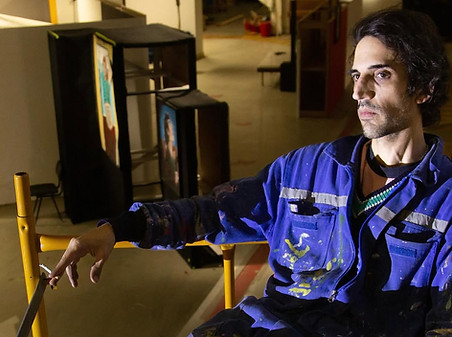
Diogo Barros Pires is a Lisbon-based artist and co-founder of Safra Lx, an artist-run workshop space in Lumiar. His crayon drawings are inhabited by recurring faces that travel from sheet to sheet, shifting between concrete people and inner archetypes. With a background in economics and consulting, he moves between the studio and the realities of running a shared space, treating both as forms of disciplined practice.
For BLAU MAP, Diogo speaks about growing into art almost by accident, balancing work habits and intuition, and why Lisbon, for him, will always be blue, white and cobblestone.
Share:

BLAU: If you had to define yourself, would you say you are an artist first? How do you keep that core identity in balance with the business side of your work, and how did you come to art in the first place?
It was never a fixed balance, it changed throughout my life according to the opportunities that came along my way. I’ve always had a connection with art. My mother used to tell me that as a child I loved to draw. Literature and poetry were constant companions during my adolescence; I read a lot and had an urge to write. This urge intensified when I started university in Lisbon: the people I befriended included several artists who encouraged my creativity and inspired me to explore other ways of expressing myself.
Even my use of crayons, a material I still use a lot, started by chance. One day my sister got a new school backpack; I took her old one to university without realizing she had left her metal box of crayons inside. When I opened the backpack on the train, I found the box and started drawing.
BLAU: What did working abroad (Prague, Istanbul, New York, etc.) give you?
People and stories that inspired me. I was lucky to meet incredible people everywhere I went. During my Erasmus in Prague, for instance, a new world opened up for me. I made friends from so many different cultures, all eager to share knowledge and passion. Each day felt fast and full: I’d meet a director, and a week later I’d be acting in his film; I’d make a simple sketch, and an art history student would introduce me to one of my favorite artists (Witkacy).
BLAU: Which cities have you lived in, and for how long in each?
Besides Lisbon, I’ve lived in Prague for about 7-8 months and in Maputo for 18 months. There were other places I stayed in often, like Madrid or Istanbul — but I never had a home there.
BLAU: Where else would you like to live?
I’ve never really thought about it. I felt good in Mexico City when I worked there; it had great energy. If the right opportunity and people appeared elsewhere, I would move
Is Lisbon your “end point”, the city you see as a final home?
Like it here; it’s where I’m from and where my family is, but we never know where life will take us.


— Describe Lisbon in 3 words.
— Blue. White. Home
BLAU: The faces that “travel” from sheet to sheet, are they the same people or archetypes?
What I paint comes from my daily life and the people who are part of it. Each phase has its own characters. The shift in plasticity can also be linked to the presence or absence of certain people. These figures may appear in an archetypal way — it’s hard not to be influenced by what came before, or they become archetypes in my own world, representing a particular feeling or situation.
BLAU: How do recurring characters evolve: do they “age,” change palette/line, or is each sheet a stand-alone episode?
Each sheet speaks for itself, but sometimes there’s a story when seen chronologically. Most of the characters are part of my life — and, like me, they’ve aged. Just as my hand has learned with each drawing done how to express in new ways what is inside of me.
BLAU: Your long or ironic titles: is that the author’s voice or the character’s voice?
The titles come from what I have done. I look at what happened and the title arrives. The painting speaks to me.
BLAU: Your figures often seem to “play roles.” Are there “witnesses” inside the composition — elements that watch on behalf of the viewer?
Sometimes the characters see what we are not seeing. Sometimes we see what they don’t. Each work has its own story
BLAU: How does scale change your work? What does 150×100 give you versus 70×50, in terms of story and the body (gesture, distance, movement)?
Scale affects which part of us marks the support. Smaller sized work just feels the weight of the finger tips, it grows and it feels the wrist, it grows and it feels the arm, it grows and it feels the body. It also changes what the work needs to be finished, very rarely what makes sense in a sketch book translate directly to a large format.


BLAU: How did Safra Lx start, and how is it different from a typical gallery or creative hub?
I was very lucky to be given the opportunity to create Safra with my partners — again, it all came down to people and chance.
I had an incredible studio that belonged to generous people who liked how I took care of the space. They introduced us to the owners, who simply handed us the key and said: “Have fun.”
The main difference at Safra is that it’s a workspace for creators who need a real workshop,a place where they can make a mess. At the same time, we don’t try to act as programmers or curators; instead, we host people who work and want to show their work, regardless of their background, in a way that dignifies it. We also try to be part of the community where we’re based. The neighborhood of Lumiar was here before us, and we want to contribute to its richness.
BLAU: How do your economics education and business experience shape your art and the way you run the space?
My background in economics and consulting gave me work habits that influence how I see artistic practice: I’m always at the studio, even if I’m not painting, I’m organizing. It also helped me plan and build the space. But now, with more than 30 resident artists, I have to juggle quite a bit as a lot of things are happening.


Photos: Hugo Macedo for Safra.lx
BLAU: Where do you have your morning coffee and where do you set up “work” meetings?
I have a simple breakfast at home, but my first coffee is always at the restaurant below my apartment while they’re preparing lunch — it’s Solar do Kadete in Cais do Sodré, a typical coal-grill restaurant. There’s also a great spot near Terreiro do Paço — A Nova Pombalina, with amazing sandwiches and juices that I wish I had more time to visit.
For different moods, there are places that stay with you: The Terrace of São Jorge; the Adamastor in Parede the place I come from and where I’m moving back now; and for good food, Zapata on Calçada do Combro (though currently closed for renovation), their octopus fillet was incredible.
Recently I’ve been going often to Nori, a Japanese restaurant, with homemade ramen and a broth I still think about long after. And every day for lunch or a quick coffee I stop at Unica da Torre in Lumiar, it looks like a simple café, but the owner, a cabinet maker who loves good food, makes excellent sandes de presunto and daily soups.
I usually meet at Safra or at my clients’ offices. Portuguese people tend to meet over lunch.
BLAU: Name places of “silence” and “noise” in the city, for work and for rest.
When I need silence, I walk from Almirante Reis to the river, you’re by yourself there. When I need to focus, I like sitting on a café terrace: it’s noisy, but the kind of noise that helps me concentrate.
And then there’s Trevo, my absolute favourite spot in Lisbon, a reference point; they do the best bifana and chicken soup, and the team is old-school Portuguese. They remember who you are and what you eat from the first moment. I recommend the grilled bifana with cheese, onion and garlic. Bourdain ended his Portugal episode there, he ate ten bifanas and ten imperiais.

BLAU: If Lisbon were a color and a texture, which ones and why?
White cobblestone. It speaks for itself. I even have some drawings called “If Rothko were from Lisbon, he would only paint cobblestones.”
BLAU: What’s a small Lisbon ritual you keep, something locals do without thinking, that you’ve adopted too?
When I’m in Baixa-Chiado, I always go to Trevo for a bifana at the counter and a glass of bubbly tap wine.
BLAU: What micro-habit did the city give you (a certain pastry at a certain hour, a tram you take just for the view, a weekly market loop)?
Complaining that no one knows how to walk on the sidewalk, while rushing to get my pastel de nata.

This interview was conducted by BLAU Studio as part of the BLAU MAP project.
Diogo Barros Pires is a Lisbon-based artist working primarily with drawing and painting, and co-founder of Safra Lx, an artist-run workshop space in Lumiar.
Instagram: @diogo_barros_pires
Reproduction or citation of this interview is permitted
only with prior written consent from the BLAU Studio team.